Emergency Plumbing: What to Do Before the Professionals Arrive
By Colossal Plumbing | Tulsa, OK
A plumbing emergency doesn’t announce itself. One moment everything is fine — the next, water is pouring through your ceiling, your toilet is overflowing, or you’re standing in two inches of water in your utility room wondering what on earth just happened.
In those first chaotic minutes, what you do matters. Acting quickly and correctly can mean the difference between a manageable repair bill and a catastrophic loss. Waiting, panicking, or doing the wrong thing can turn a bad situation into a significantly worse one.
This guide covers exactly what to do — step by step — from the moment a plumbing emergency strikes until our team arrives at your door.
Step 1: Stay Calm and Assess the Situation
This sounds obvious, but it’s worth saying. Panic leads to poor decisions, and poor decisions in a plumbing emergency can make things worse. Take five seconds to look around and understand what’s happening before you act.
Ask yourself:
- Is water actively flowing or has it stopped?
- Is the problem isolated to one fixture, or is it affecting multiple areas of the home?
- Is there any risk of electrical hazard — water near outlets, panels, or appliances?
- Is there a gas smell accompanying the plumbing issue?
Your answers will guide what you do next. A burst pipe actively flooding your basement demands immediate action. A slow leak under a sink that’s been dripping for an hour gives you a moment to think.
If you smell gas at any point — stop everything. Leave the house immediately, don’t use any light switches or appliances, and call your gas company and 911 from outside. Gas leaks are a different emergency entirely and require a different response.
Step 2: Shut Off the Water Supply
This is the single most important action you can take in almost any plumbing emergency. Stopping the flow of water stops the damage from getting worse.
Know where your shut-off valves are before an emergency happens. There are two types you need to be aware of:
Fixture Shut-Off Valves
These small oval or lever-shaped valves are located under sinks and behind toilets. They control water supply to that specific fixture only. If the problem is isolated — an overflowing toilet, a leaking faucet, a broken supply line under a sink — turn the valve clockwise to shut off water to just that fixture. This lets the rest of your home’s plumbing continue to function normally while you wait for help.
The Main Shut-Off Valve
If the problem is more widespread — a burst pipe inside a wall, a main line failure, or water coming from an unknown source — you need to shut off the main water supply to the entire house. In most Tulsa homes, the main shut-off valve is located:
- In the utility room or basement near where the main line enters the house
- In a crawl space near the front foundation wall
- Outside near the water meter at the street (often in a covered box in the ground)
Turn the valve clockwise to close it. If it’s a ball valve with a lever handle, turn the lever perpendicular to the pipe.
Important: Make sure every adult in your household knows where the main shut-off valve is and how to operate it. This is not information to look up during an emergency.
Step 3: Turn Off the Water Heater
Once you’ve shut off the main water supply, turn off your water heater. This is a step many homeowners skip — and it can be a costly mistake.
When a tank water heater runs without a water supply, the heating elements can burn out or the tank can overheat and crack. If you have a gas water heater, turn the dial to the “Pilot” setting. If you have an electric water heater, turn off the dedicated breaker in your electrical panel.
This takes thirty seconds and can save you from replacing your water heater on top of whatever else you’re dealing with.
Step 4: Address Active Flooding
If water is actively accumulating on your floors, acting quickly limits damage to flooring, drywall, cabinetry, and anything stored at floor level.
Move valuables and electronics immediately. Get laptops, documents, rugs, and anything else that can be damaged away from the water as fast as possible.
Use towels, mops, or a wet-dry vacuum to remove standing water. The faster water is off your floors, the less damage it causes — especially to hardwood or laminate flooring, which can warp quickly when wet.
Open cabinet doors under sinks in affected areas to allow air circulation and prevent mold from developing inside enclosed spaces.
If water is coming through the ceiling from an upstairs leak, place buckets to collect the drips and puncture the ceiling drywall at the lowest point of any visible bulge. This sounds counterintuitive, but a controlled release of water through a small hole does far less damage than a saturated ceiling collapsing under its own weight.
Step 5: Document Everything Before Cleanup
Before you do any significant cleanup, pull out your phone and take photos and video of everything — the source of the problem, the affected areas, standing water, damaged belongings, everything. Walk through every affected room and document thoroughly.
This documentation is essential for your homeowner’s insurance claim. Insurers want to see the extent of damage before cleanup begins. Photos taken after the fact, or a cleaned-up space with no evidence of what happened, make claims significantly harder to support.
Document first. Clean up second.
Step 6: Ventilate the Affected Areas
Once the immediate crisis is under control and you’ve documented the damage, open windows and doors in affected areas to begin the drying process. If you have fans, position them to move air across wet surfaces.
This matters more than most homeowners realize. Water that sits in enclosed spaces — under flooring, inside walls, in ceiling cavities — creates ideal conditions for mold growth within 24 to 48 hours. Ventilation buys time until professional drying equipment can be brought in if needed.
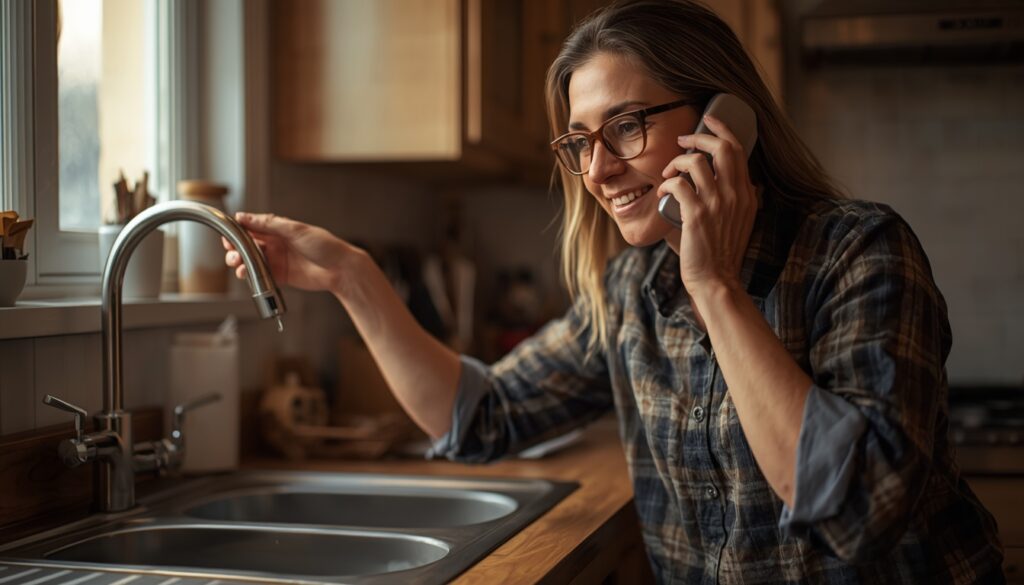
Step 7: Call Colossal Plumbing
This step should happen as soon as the water is off — not after you’ve finished cleanup, not after you’ve called your insurance company, not after you’ve tried to diagnose the problem yourself.
The sooner a licensed plumber is on the way, the sooner your home’s plumbing is restored and the sooner you can begin the recovery process. Colossal Plumbing’s emergency line is staffed 24 hours a day, 7 days a week, 365 days a year. When you call, a real person answers and a licensed plumber is dispatched immediately.
When you call, be ready to tell us:
- What you’re seeing — where the water is coming from, how fast it’s flowing, what fixtures or areas are affected
- Whether you’ve been able to shut off the water supply
- Your address and the best way to access the property
- Any relevant context — age of the home, recent plumbing work, anything unusual you noticed before the problem started
This information helps us arrive prepared with the right equipment for your specific situation.
Common Plumbing Emergencies and What to Do
Burst Pipe
Shut off the main water supply immediately. Open a cold water faucet on the lowest level of your home to drain remaining pressure from the pipes. Document the damage and call us.
Overflowing Toilet
Turn off the fixture shut-off valve behind the toilet immediately — do not flush again. If the shut-off valve is inaccessible or not working, shut off the main supply. Remove the toilet tank lid and push the flapper down to stop water from continuing to run into the bowl. Call us.
Sewage Backup
Do not use any drains or toilets in the home — adding water to a backed-up sewer line makes it worse. Keep children and pets away from affected areas. Open windows for ventilation. Call us immediately. Sewage backup is a health hazard that requires professional attention without delay.
Water Heater Leak or Failure
Shut off the water supply to the water heater using the cold water inlet valve at the top of the unit. For gas units, turn the dial to “Pilot.” For electric units, switch off the breaker. If the tank is leaking significantly, attach a garden hose to the drain valve and run it to a floor drain to relieve water pressure. Call us.
Frozen Pipe
Do not use an open flame to thaw a frozen pipe. Apply a heating pad, hair dryer on low heat, or warm towels to the exterior of the pipe, working from the faucet end toward the frozen section. Keep a faucet open so water can flow as the pipe thaws. If you can’t locate the frozen section, or if you suspect the pipe may have already cracked, shut off the main supply and call us.
What to Expect When We Arrive
When our plumber arrives, we’ll assess the situation quickly, identify the source of the problem, and give you a clear picture of what’s needed and what it will cost before any work begins. We don’t start repairs without your approval — even in emergencies.
We arrive fully stocked for the most common plumbing emergencies, which means fewer delays and faster resolution. Our goal is to get your home’s plumbing back to normal as quickly and cleanly as possible.
Be Prepared Before an Emergency Strikes
The best time to prepare for a plumbing emergency is before one happens. Take fifteen minutes this week to:
- Locate your main shut-off valve and make sure every adult in the household knows where it is
- Check the shut-off valves under each sink and behind each toilet — make sure they turn freely and haven’t seized from disuse
- Save our number in your phone: (918) 553-0138 — available 24/7
- Know your water heater type (gas or electric) and how to shut it off in an emergency
These small preparations can make an enormous difference when seconds count.
Colossal Plumbing — Tulsa’s Emergency Plumbing Team
Colossal Plumbing provides 24/7 emergency plumbing services throughout Tulsa and the surrounding metro area, including Broken Arrow, Owasso, Bixby, Jenks, Sand Springs, Sapulpa, Claremore, Catoosa, Collinsville, Glenpool, Skiatook, Coweta, and South Tulsa.
When a plumbing emergency hits, we’re ready. Call (918) 553-0138 — any time, any day. A real person answers, and a licensed plumber is on the way.
Colossal Plumbing — Licensed, bonded, and insured for residential and commercial plumbing throughout Oklahoma. Serving the Tulsa metro since 2001.
