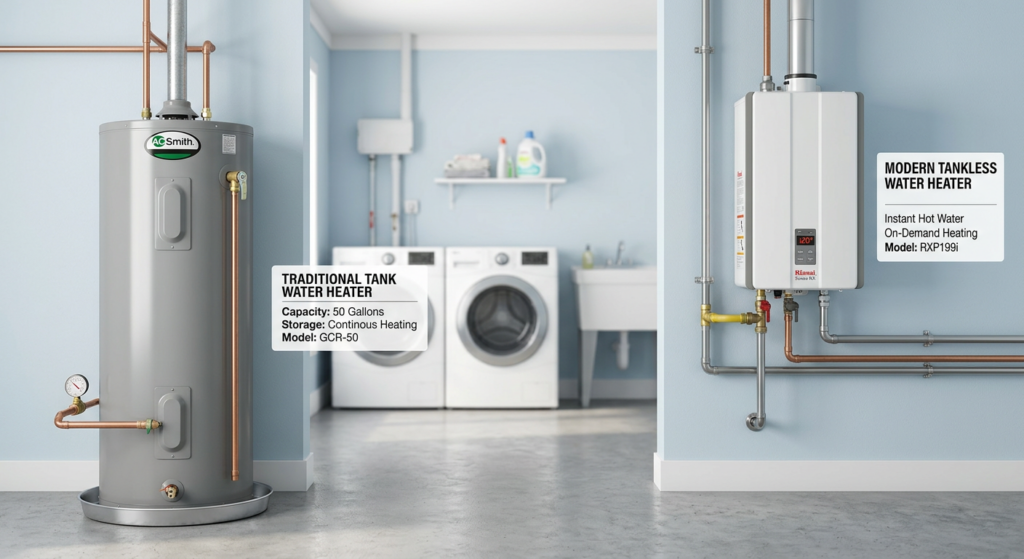
How to Choose Between Tank and Tankless Water Heaters
By Colossal Plumbing | Tulsa, OK
If your water heater is aging out or you’re building new, you’ll face a choice that more Tulsa homeowners are thinking carefully about: stick with a traditional tank water heater, or make the switch to a tankless system?
Both options have genuine advantages. Both have real limitations. And the right answer depends on your household size, your budget, your home’s infrastructure, and how you use hot water day to day.
This guide will walk you through everything you need to know to make a confident, informed decision — without the sales pressure.
How Each System Works
Before comparing the two, it helps to understand how they operate.
Tank water heaters store a large volume of water — typically 40 to 80 gallons — and keep it heated continuously, ready to use whenever you turn on a tap. When hot water leaves the tank, cold water enters to replace it and the heating cycle begins again. Because the tank is always maintaining temperature, some energy is consumed even when no hot water is being used. This is called standby heat loss.
Tankless water heaters — also called on-demand or instantaneous water heaters — have no storage tank at all. Instead, water passes through a heat exchanger and is heated only when you actually need it. Turn on the hot water tap and the unit fires up; turn it off and it shuts down. Because there’s no stored water to keep warm, standby heat loss is essentially eliminated.
The Case for a Tank Water Heater
Traditional tank water heaters have been the standard in American homes for generations — and for good reason. They’re reliable, well-understood, widely serviceable, and significantly less expensive to purchase and install.
Lower Upfront Cost
A quality tank water heater typically costs between $500 and $1,200 installed, depending on size and fuel type. That’s a fraction of what most tankless systems run, making tanks the clear choice when budget is the primary concern.
Simple Installation
Tank water heaters work with your existing gas line or electrical setup in most cases. There’s no need to upgrade your electrical panel, resize your gas line, or add new venting — factors that can add significant cost to a tankless installation.
Works Well for High Simultaneous Demand
Because a tank stores a large volume of pre-heated water, it can deliver hot water to multiple fixtures at the same time without a drop in temperature — provided the tank is appropriately sized for your household. A well-sized tank can handle back-to-back showers, a running dishwasher, and a washing machine simultaneously without complaint.
Familiar and Easy to Service
Tank water heaters are among the most straightforward appliances a plumber works on. Parts are widely available, most plumbers know them inside and out, and repairs are generally uncomplicated and affordable.
The Limitation: Finite Hot Water and Running Costs
The main drawback of a tank system is that once you’ve used the stored hot water, you wait while the tank recovers. For larger households with heavy morning demand, running out of hot water is a real frustration. And because the tank runs continuously to maintain temperature, energy costs are higher over the life of the unit than with a tankless system.
The Case for a Tankless Water Heater
Tankless water heaters have grown significantly in popularity over the past decade as prices have come down and Tulsa homeowners have become more focused on long-term energy efficiency.
Endless Hot Water
This is the headline benefit, and it’s a real one. A properly sized tankless system never runs out of hot water. Whether it’s the fifth shower of the morning or a long soak in a deep tub, hot water is there as long as you need it. For larger families or households with high demand, this alone is often the deciding factor.
Lower Energy Bills
Because tankless units only heat water on demand, they eliminate the standby heat loss that tank systems experience around the clock. The U.S. Department of Energy estimates that tankless water heaters can be 24 to 34 percent more energy efficient than tank models for homes that use a typical amount of hot water. Over a 15 to 20-year lifespan, those savings add up significantly.
Longer Lifespan
A well-maintained tankless water heater typically lasts 20 years or more — nearly double the lifespan of a conventional tank unit. For homeowners planning to stay in their home long-term, this extended life expectancy helps offset the higher upfront cost.
Space Savings
Tankless units are compact and wall-mounted, freeing up the floor space that a traditional 50-gallon tank occupies. In Tulsa homes where utility closets and mechanical rooms are small, this can be a meaningful advantage.
The Limitations: Higher Upfront Cost and Installation Requirements
Tankless systems cost significantly more to purchase and install — typically $1,500 to $3,500 or more depending on the unit and what infrastructure upgrades are needed. Gas-powered tankless units often require a larger gas line than your existing tank system used. Electric tankless units may require an electrical panel upgrade. These aren’t reasons to rule out a tankless system, but they need to be factored into your total cost calculation.
Tankless units also require annual descaling maintenance — particularly important in the Tulsa area where hard water accelerates mineral buildup in the heat exchanger. Skipping this maintenance shortens the life of the unit and reduces efficiency.
Key Factors to Guide Your Decision
Household Size and Hot Water Usage
For smaller households — one to three people with moderate hot water use — a well-sized tank unit typically performs well and offers excellent value. For larger households of four or more people, or any household where running out of hot water is a regular frustration, a tankless system is worth the investment.
How Long You Plan to Stay in the Home
If you’re planning to sell in the next few years, the return on a tankless installation may not fully materialize. A high-quality tank replacement is often the smarter financial move for a shorter time horizon. If you’re in your long-term home, the energy savings and extended lifespan of a tankless unit make a compelling financial case.
Your Existing Infrastructure
This is where a conversation with a licensed plumber becomes valuable. If your home’s gas line and electrical panel already support a tankless installation without upgrades, the cost differential narrows considerably. If significant infrastructure work is needed, the total installed cost of a tankless system rises — sometimes substantially. A proper assessment of your home’s current setup gives you an accurate picture of what you’re actually comparing.
Your Water Quality
Tulsa’s water is moderately hard, which means mineral deposits are a fact of life for any water heater. Tank systems are somewhat more forgiving of hard water — annual flushing keeps them in good shape. Tankless systems are more sensitive and require diligent descaling. If you’re not interested in annual maintenance, a tank system may be the more practical choice.
Budget
Be honest about what you can afford today versus what makes sense over time. A tankless system’s total cost of ownership over 20 years is often lower than replacing a tank unit twice — but that calculation only works if you can absorb the higher upfront cost. If budget is tight, a quality tank system installed properly will serve your family well for a decade or more.
A Side-by-Side Comparison
| Tank Water Heater | Tankless Water Heater | |
|---|---|---|
| Upfront cost | $500–$1,200 installed | $1,500–$3,500+ installed |
| Lifespan | 10–12 years | 20+ years |
| Hot water supply | Limited by tank size | Unlimited |
| Energy efficiency | Lower (standby heat loss) | Higher (on-demand only) |
| Installation complexity | Simple | May require upgrades |
| Maintenance | Annual flush, anode rod | Annual descaling |
| Space required | Larger footprint | Compact, wall-mounted |
| Best for | Smaller households, tighter budgets | Larger households, long-term savings |
What About Hybrid Heat Pump Water Heaters?
Worth a mention: hybrid heat pump water heaters are a third option that combines a tank with heat pump technology to achieve efficiency levels that rival tankless systems at a lower upfront cost than most tankless installations. They work best in climates with mild temperatures and in spaces with adequate air volume — a utility room or garage rather than a closet. If you’re interested in exploring this option, ask our team whether your home is a good candidate.
Let Colossal Plumbing Help You Decide
The right water heater for your home depends on factors that are specific to your family, your budget, and your property. At Colossal Plumbing, we don’t push one system over the other — we give you an honest assessment of both options in the context of your actual situation, so you can make the decision that’s right for you.
We install, repair, and maintain both tank and tankless water heaters throughout the Tulsa metro, including Broken Arrow, Owasso, Bixby, Jenks, Sand Springs, Sapulpa, Claremore, and surrounding communities.
Call us at (918) 553-0138 to schedule a water heater consultation, or request a free quote online. We’ll help you figure out exactly what your home needs — and get it installed right.
Colossal Plumbing — Tulsa’s trusted plumbing experts. Licensed, bonded, insured, and serving the Tulsa metro since 2001.
