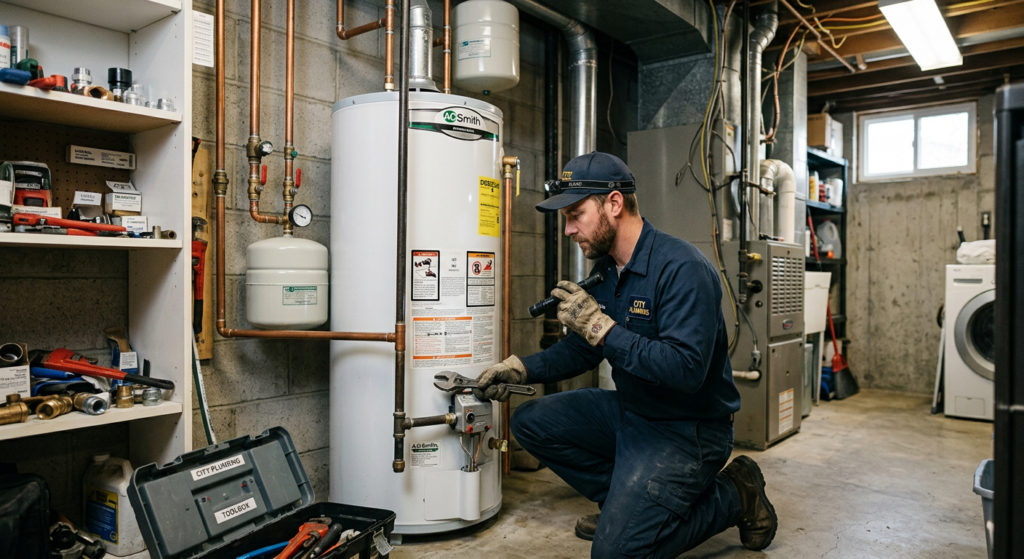
If you have been told your water heater needs an expansion tank, here is the short answer: an expansion tank is a small tank installed on the cold water line near your water heater that gives heated water a safe place to expand. When water heats up, it takes up more space. If your plumbing system is closed off from the city supply, that extra volume has nowhere to go, pressure rises, and your water heater and fixtures take the stress.
Does every Tulsa home need one? No — but many do, especially newer homes and homes where a backflow preventer, check valve, or pressure-reducing valve keeps water from pushing back toward the street. If you are replacing a water heater, or your temperature and pressure relief valve keeps dripping, an expansion tank is worth a serious look.
What an expansion tank actually does
Think of it as a pressure cushion. Inside the small tank is a rubber diaphragm: one side holds air, the other connects to your water line. When water in your heater warms and expands, the extra water pushes into the tank and compresses the air. When you open a faucet, that stored pressure pushes it back out.
Without that cushion, thermal expansion has to go somewhere. In an open system, it can push back toward the municipal supply; in a closed system, it cannot, so pressure climbs every time the heater runs, then drops when someone uses water. That repeated rise and fall strains the whole system.

Where you will find it — and what it looks like
An expansion tank is usually a small, round or cylindrical tank on or near the cold water pipe above or beside the water heater. It is much smaller than the heater itself — closer to a large canister — and may sit upright, hang from the pipe, or rest on a support.
It is not the same as the temperature and pressure relief valve, often called the T&P valve — a safety device on the water heater that opens if temperature or pressure gets dangerously high. An expansion tank helps keep everyday pressure from climbing in the first place. One does not replace the other: a healthy system needs the T&P valve working correctly whether or not an expansion tank is installed.
Does your home need one? Start with whether your system is closed
The key question is not how old your water heater is, but whether your home has a closed plumbing system — one where something between your house and the street stops water from flowing backward. Common examples include:
- A backflow preventer installed to protect the public water supply
- A check valve on the incoming water line
- A pressure-reducing valve (PRV) that lowers street pressure for the house
Many newer Tulsa homes in Broken Arrow, Owasso, Bixby, Jenks, and Sand Springs were built with one or more of these devices, and older homes often gain one during a remodel, a meter change, or a water heater replacement. Once any is in place, heated water cannot expand back toward the street, so an expansion tank becomes the practical place for that volume to go.
If your system is truly open, an expansion tank may not be required for thermal expansion. The honest way to know is to have the incoming arrangement and household water pressure checked, rather than guessing from the house’s age.
Signs your home may be missing — or outgrowing — an expansion tank
Pressure problems rarely announce themselves clearly, but watch for these clues:
- The T&P relief valve drips or discharges from time to time, even though the temperature setting is reasonable
- Water pressure feels stronger first thing in the morning or after the heater has run, then normalizes after a faucet opens
- Faucets, toilets, or supply lines develop leaks sooner than expected
- You hear banging in the pipes after the water heater runs
- A recently replaced water heater ages fast, with valve or fitting problems showing up early
None of these proves on its own that you need an expansion tank — a dripping T&P valve can also mean the valve is failing or the temperature is set too high. Diagnosis matters. For related background, see our guide to what temperature to set your water heater to and what to do if your water heater is leaking.

What happens if a closed system has no expansion tank?
At first, maybe nothing obvious. Over time, repeated pressure spikes can shorten your water heater’s life, wear out toilet fill valves and faucet cartridges, stress washer and dishwasher hoses, and make the T&P valve weep. A valve that opens often can fail to reseat, turning a small drip into a steady leak.
An expansion tank is not an upsell accessory. In a closed system it lets water expanding as it heats happen without punishing everything connected to the pipes.
What you can safely check yourself
No tools or training are needed for a useful first look:
- Look at the cold water line near the water heater for a small tank connected to it. If there is one, you already have an expansion tank.
- Check around the water heater and under the T&P discharge pipe for dampness or a slow drip.
- Note when pressure feels high — first thing in the morning, or after long heating cycles with no water use?
- Note your water heater’s age and model if it is being replaced — your plumber will size any expansion tank to the heater and your household pressure.
Stop there. Do not tap, drain, or try to repressurize an expansion tank yourself, and do not cap a dripping relief valve. Both involve pressure, and a capped relief valve is a genuine safety hazard.
What a professional installation involves
Installing an expansion tank is straightforward for a licensed plumber, but sizing and setup matter: the tank must match your water heater, and its air charge must match your home’s incoming water pressure. A tank that is too small, or charged to the wrong pressure, will not absorb expansion as it should and can fail early.
A proper visit includes checking household water pressure, confirming whether your system is closed, sizing and mounting the tank with proper support, and verifying the T&P valve and water heater afterward. If your water heater is due for replacement anyway, that is the natural time to address the expansion tank too. Our Water Heater Services page covers installation and repair, and if you are weighing a change of system, our honest guide to tankless water heaters in Tulsa is a helpful companion read.
Costs vary with tank size, existing piping, and other pressure issues, so the only accurate price is a quote for your home. Be cautious of any flat answer given without looking at the system.
Frequently asked questions
Is an expansion tank the same as a pressure tank for a well?
No. They look similar and both use an air cushion, but a well pressure tank serves a private well pump system. An expansion tank on a city-water home exists specifically to absorb thermal expansion from water heating in a closed system.
Do tankless water heaters need expansion tanks?
Sometimes. A tankless unit heats water on demand rather than storing it, so the expansion picture is different, but a closed system can still build pressure — especially if there is also a storage or recirculation arrangement. Whether one is needed depends on your piping and valves, which is why it should be checked rather than assumed either way.
How long does an expansion tank last?
Like the diaphragm inside it, an expansion tank is a wear item and will not last as long as the plumbing around it. If yours is heavy, waterlogged, rusting, or your pressure symptoms have returned, have it checked — replacement is normally a simple job when the tank itself is the problem.
Not sure whether your Tulsa home needs one?
Colossal Plumbing can check your water pressure, tell you plainly whether your system is closed, and let you know if an expansion tank would help — or if something else is causing your symptoms. Call us at (918) 553-0138 or reach us through our contact / Get a Quote page. We are available Mon–Sat 7 AM–7 PM, with 24/7 emergency service across Tulsa and the surrounding area, including Broken Arrow, Owasso, Bixby, Jenks, Sand Springs, Sapulpa, and Claremore.
