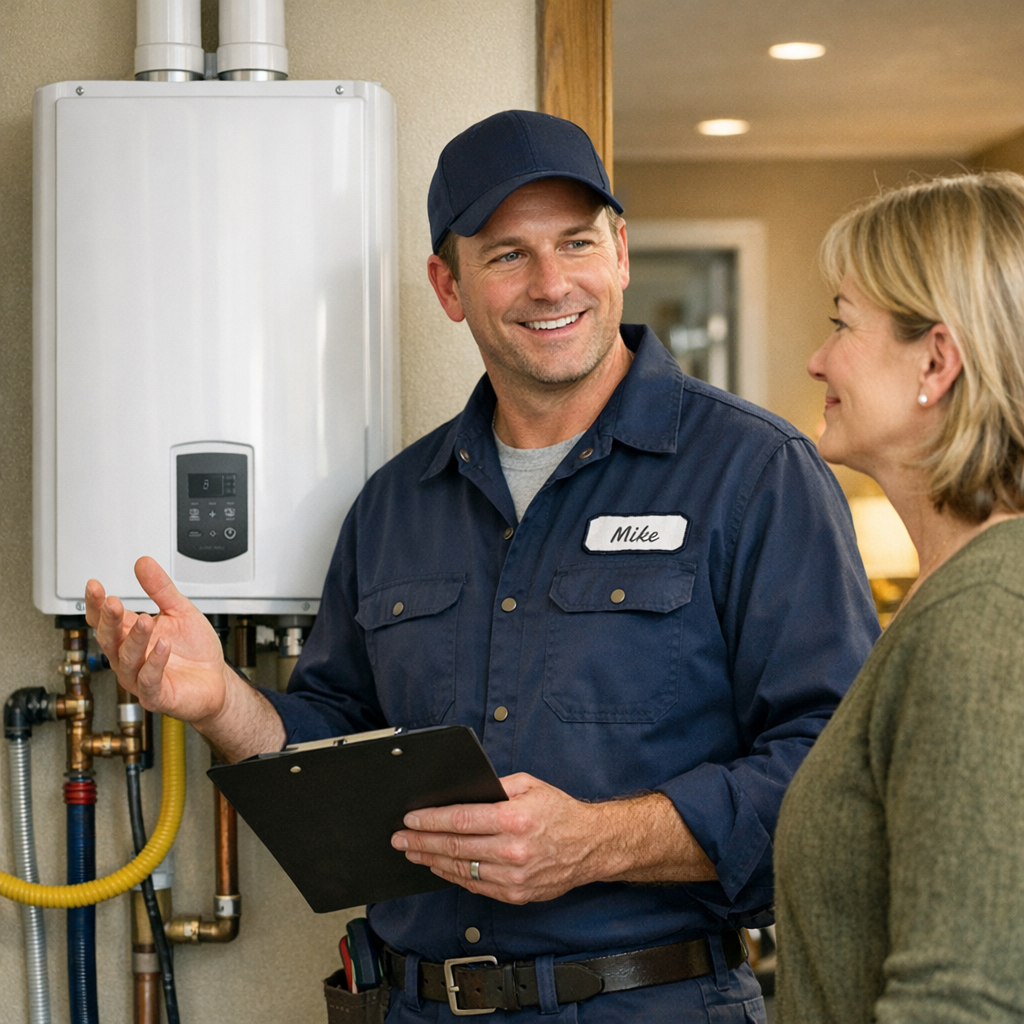
Tankless vs. Regular Water Heaters: Choosing the Right Fit for You
By Colossal Plumbing | Tulsa, OK
Walk into any home improvement store and you’ll find two very different types of water heaters staring back at you. One is the traditional tank unit you grew up with — a tall cylinder humming quietly in the corner of the utility room. The other is a compact, wall-mounted unit that looks almost industrial compared to its older counterpart.
Both heat water. Both have their place. And the question of which one belongs in your home isn’t answered by which is “better” in the abstract — it’s answered by what your household actually needs.
At Colossal Plumbing, we install and service both types throughout the Tulsa area, and we have honest conversations with homeowners about this choice every week. Here’s how we think about it.
The Fundamental Difference
The core distinction between these two systems is simple: one stores hot water, the other makes it.
A regular tank water heater maintains a reservoir of hot water — anywhere from 30 to 80 gallons — at a constant temperature around the clock. Hot water is always available the moment you need it, but the tank can only supply as much as it holds before you have to wait for it to reheat.
A tankless water heater has no reservoir at all. It heats water instantaneously as it passes through the unit, triggered by the flow of water when you open a tap. It can’t run out of hot water because it never stores it — but it does have a limit to how much it can heat simultaneously.
Everything that flows from these two approaches — the costs, the benefits, the limitations, the maintenance requirements — follows from this fundamental design difference.
The Real-World Experience: What Homeowners Actually Notice
Before we get into numbers and specs, it helps to understand what the difference actually feels like to live with.
Living With a Tank Water Heater
For most households, life with a tank water heater is perfectly comfortable the majority of the time. Hot water is instantaneous when the tank has supply, recovery is relatively quick for modern high-efficiency units, and the system operates silently and reliably in the background.
The moments when a tank water heater’s limitations show up are specific and predictable:
- The fourth consecutive shower on a busy morning runs cold
- You run the dishwasher, start a load of laundry, and then try to shower — and the pressure or temperature isn’t quite right
- Your tank is undersized for your household and the 20-minute recovery wait is a daily frustration
For smaller households — one or two people with moderate hot water habits — these scenarios may rarely or never arise. For a family of five with two teenagers and a gym schedule, they might be a weekly source of friction.
Living With a Tankless Water Heater
Life with a properly installed, correctly sized tankless system is — for most households — simply better in the ways that matter most. You never run out of hot water. You can fill a soaking tub and shower immediately after. You stop thinking about whether someone is in the shower before you start the dishwasher.
The adjustment period is real but brief. Tankless units take a second or two longer to deliver hot water to distant fixtures compared to a tank that’s been keeping water warm all day — a minor trade-off that most homeowners stop noticing within a week.
The other reality of tankless ownership is the maintenance schedule. Annual descaling is not optional in the Tulsa area, where moderately hard water accelerates mineral buildup inside the heat exchanger. Homeowners who stay on top of annual maintenance get the full 20-plus year lifespan from their unit. Those who don’t can see efficiency drop and lifespan shorten significantly. This isn’t a dealbreaker — it’s just something to know going in.
Comparing the Numbers
Upfront Cost
This is where tank water heaters win clearly and significantly. A quality 50-gallon gas tank water heater, installed, typically runs $600 to $1,200 in the Tulsa area depending on the unit and any infrastructure adjustments needed.
A tankless gas installation runs $1,500 to $3,500 or more — and that range is wide for a reason. If your existing gas line can handle the higher BTU demand of a tankless unit without modification, costs are at the lower end. If the gas line needs to be upsized, or venting needs to be rerouted, or your water supply needs a filter to protect the heat exchanger, costs climb accordingly. An honest pre-installation assessment tells you exactly where you’ll land.
Operating Cost
This is where tankless wins, and over time it wins significantly.
Tank water heaters lose energy continuously through what’s called standby heat loss — the warmth that radiates through the tank walls and into the surrounding air even when no hot water is being used. Modern tanks are better insulated than older models, but standby loss remains an inherent characteristic of the design.
Tankless units have essentially zero standby loss. They consume energy only when hot water is flowing. The U.S. Department of Energy estimates 24 to 34 percent greater efficiency for tankless units in average-usage homes — savings that compound meaningfully over a 15 to 20-year lifespan.
For a family spending $400 to $600 per year on water heating, that efficiency difference represents $100 to $200 in annual savings. Over 20 years, that’s $2,000 to $4,000 — enough to offset the higher installation cost and then some, particularly when you factor in that a tankless unit won’t need to be replaced in that same period while a tank likely will.
Lifespan
Tank water heaters last 10 to 12 years on average with proper maintenance. Tankless units last 20 years or more — often significantly longer in homes with good water quality and consistent annual maintenance.
If you’re buying a home and planning to stay for 30 years, a tankless unit installed today may never need to be replaced during your ownership. A tank unit installed today will need to be replaced at least twice in that same period — each time at current installation costs, which tend to rise over time.
Space
A 50-gallon tank water heater occupies roughly 9 to 12 square feet of floor space including clearance. A tankless unit mounts on the wall and takes up almost none. In utility rooms, mechanical closets, and tight spaces, this matters more than it might seem.
Key Questions to Guide Your Decision
Rather than telling you which system is right, these questions help you arrive at the answer yourself.
How many people live in your home? One or two people with moderate hot water use will rarely feel the limitations of a well-sized tank system. Four or more people — especially if schedules overlap — benefit most from the unlimited supply a tankless system provides.
How long are you planning to stay? If you’re selling in two or three years, the higher upfront cost of a tankless system is harder to justify — you may not recoup the investment. If you’re in your long-term home, the math almost always favors tankless over a full ownership horizon.
What does your existing infrastructure look like? This is the question you genuinely can’t answer without a professional assessment. Gas line sizing, venting configuration, and electrical supply are all factors that significantly affect the true installed cost of a tankless system. A thorough pre-installation evaluation from a licensed plumber gives you an accurate picture before you commit.
Are you willing to commit to annual maintenance? Tankless systems reward homeowners who maintain them and underperform for those who don’t. If annual descaling service feels like a burden, a tank system — which requires less frequent attention — may be a better practical fit for your household, even if the numbers favor tankless on paper.
What is your primary pain point with your current system? If you regularly run out of hot water, a tankless system solves your problem directly. If your current system works fine but you’re replacing an aging unit and want to make a smart long-term investment, either option can work — and the right choice depends on the factors above.
What About Electric Tankless Units?
For homes without natural gas — or for homeowners who prefer to avoid gas appliances — electric tankless water heaters are available, but they come with an important caveat: whole-home electric tankless units draw extremely high amperage and almost always require a significant electrical panel upgrade to install. In many cases, the cost of that upgrade alone exceeds what a gas tankless installation would have cost in a gas-equipped home.
Point-of-use electric tankless units — small units installed directly at a single fixture like a bathroom sink or a remote shower — are a different matter entirely. These are inexpensive, easy to install, and genuinely useful for fixtures that are far from the main water heater and suffer from long wait times for hot water to arrive.
If you’re considering electric tankless, have an electrician assess your panel before you commit to anything. It’s the most important piece of information you need.
Our Honest Take
At Colossal Plumbing, we don’t steer homeowners toward one system or the other based on what’s more profitable for us. We tell you what we’d put in our own homes given your specific situation.
For a family of four or more planning to stay in their home long-term, with a gas line that can support a tankless unit without major modification: tankless is almost always the right call. The unlimited hot water, the energy savings, and the extended lifespan make a compelling case.
For a single person or couple, a homeowner on a tight budget, or anyone selling their home in the next few years: a quality high-efficiency tank unit is a perfectly sound choice that will serve you well.
For everyone else — it depends on your infrastructure, your habits, and your priorities. That’s exactly what a pre-installation consultation is for.
Serving Tulsa Homeowners with Both Options
Colossal Plumbing installs, services, and maintains both tank and tankless water heaters throughout the Tulsa metro area, including Broken Arrow, Owasso, Bixby, Jenks, Sand Springs, Sapulpa, Claremore, Catoosa, Collinsville, Glenpool, Skiatook, Coweta, and South Tulsa.
Call (918) 553-0138 to schedule a free water heater consultation. We’ll assess your home, walk you through both options honestly, and give you a clear upfront quote on whichever direction makes sense for your household — with no pressure either way.
Colossal Plumbing — Licensed, bonded, and insured for residential and commercial plumbing throughout Oklahoma. Serving the Tulsa metro since 2001.
